NetBox RPKI Plugin
Bring RPKI inventory, validation, routing intent, and hosted-provider workflows into NetBox 4.5.x.
netbox_rpki extends NetBox with a broad RPKI data model plus the operational workflows needed to ingest validator state, model publication intent, reconcile intent against published objects, and manage write-back to supported providers. The detailed reference documentation lives in the Sphinx site; this README is the top-level summary required to evaluate whether the plugin fits a deployment.

Free software: Apache-2.0
Summary
The plugin is aimed at operators who want NetBox to hold both raw RPKI state and higher-level publication intent.
Track native RPKI inventory such as certificates, ROAs, ASPAs, manifests, signed objects, repositories, and publication points
Import external observations from validators and hosted providers
Author ROA and ASPA intent, simulate changes, reconcile drift, and retain approval history
Expose the same object families through the NetBox UI, REST API, GraphQL, tables, and navigation
Compatibility
netbox-plugin.yaml
The plugin declares NetBox compatibility for the 4.5.x release line. Verification has been completed against real development installs of NetBox 4.5.0 and NetBox 4.5.7, covering plugin bootstrap, manage.py check, provider-sync, models, API, GraphQL, view, and navigation suites, browser smoke testing, and the full routing-intent and bulk-authoring workflow.
NetBox |
Python |
Status |
Notes |
|---|---|---|---|
4.5.0 |
3.12 |
GA |
Release-gated developer install verified end-to-end. |
4.5.7 |
3.12 |
GA |
Release-gated developer install verified end-to-end. |
4.5.x |
3.12 |
Beta |
Supported release line, but exact patch combinations other than the GA anchors are not release-gated. |
4.5.x |
3.13 - 3.14 |
Best effort |
Allowed for operator evaluation and covered by the compatibility contract tests, but not release-gated. |
< 4.5 or >= 4.6 |
any |
Unsupported |
Outside the plugin compatibility window. |
4.5.x |
< 3.12 or > 3.14 |
Unsupported |
Outside the documented Python range. |
Non-GA combinations emit a runtime RuntimeWarning during plugin startup so unsupported and best-effort deployments are visible before operators proceed.
Operators can also run manage.py diagnose_netbox_rpki --format text|json after installation to verify plugin registration, migrations, Redis-backed job prerequisites, and integration wiring before troubleshooting workflow-specific failures.
Contributors who need a real hosted-provider integration path without RIR test credentials can use the documented public Krill testbed workflow in LOCAL_DEV_SETUP.md, including the devrun/public-krill-testbed.sh helper for the live-provider lane.
Dependencies
Component |
Required for |
Supported versions |
Notes |
|---|---|---|---|
NetBox |
All plugin functionality |
4.5.0 to 4.5.99 |
The certified support window currently targets the NetBox 4.5 release line. |
Python |
All plugin functionality |
3.12 to 3.14 |
3.12 is the release-gated version today. |
PostgreSQL |
NetBox runtime and tests |
NetBox-supported versions for 4.5.x |
Required by NetBox itself; the plugin does not replace this dependency. |
Redis |
NetBox runtime and tests |
NetBox-supported versions for 4.5.x |
Required by NetBox task and caching subsystems. |
Routinator |
Validator import workflows |
Current API compatible |
Optional unless validator-ingest features are used. |
Krill |
Hosted-provider sync and write-back workflows |
API-compatible Krill deployments |
Optional unless Krill-backed provider workflows are used. |
ARIN RPKI API |
Hosted-provider sync workflows |
Current ARIN API behavior supported by the plugin |
Optional unless ARIN-backed provider workflows are used. |
IRRd-compatible service |
IRR snapshot and coordination workflows |
IRRd-compatible HTTP/WHOIS source |
Optional unless IRR ingest and coordination workflows are used. |
Node.js and Playwright |
Browser E2E development workflow |
Node 18+ and the Playwright version pinned in |
Optional for plugin runtime; used only for browser smoke tests. |
Installation
For adding to a NetBox Docker setup see the general instructions for using netbox-docker with plugins.
Install using pip:
pip install netbox_rpki
or by adding to your local_requirements.txt or plugin_requirements.txt (netbox-docker):
netbox_rpki
Enable the plugin in /opt/netbox/netbox/netbox/configuration.py,
or if you use netbox-docker, your /configuration/plugins.py file :
PLUGINS = [
   'netbox_rpki'
]

PLUGINS_CONFIG = {
   "netbox_rpki": {
      'top_level_menu': False,
      'structured_logging': {
         'debug_subsystems': ['provider_sync', 'provider_write'],
      },
   },
}
Run python -m manage.py migrate from the NetBox project directory in your installation, then run python manage.py check to confirm the plugin loads cleanly.
structured_logging.debug_subsystems accepts subsystem names such as provider_sync, provider_write, irr_sync, irr_write, external_validation, lifecycle_hooks, and jobs. When enabled, those subsystems emit additional structured debug events with consistent redaction of credentials, bearer/basic auth headers, webhook signatures, and write payload bodies.
Subsystem Maturity
The plugin spans subsystems at different stages of maturity. Each navigation group carries a maturity tag so operators can evaluate stability expectations before relying on a feature in production.
Maturity |
Badge |
Meaning |
|---|---|---|
GA |
(none) |
Stable, contract-tested, and not expected to break within the release line. |
Beta |
β |
Feature-complete and tested but may evolve across minor releases. |
Experimental |
⚠ |
Early-stage; may change significantly or be restructured. |
Subsystem |
Maturity |
|---|---|
Resources |
GA |
ROAs |
GA |
Objects |
GA |
Trust |
GA |
Validation |
GA |
Intent |
Beta |
Derivation |
Beta |
Reconciliation |
Beta |
Provider |
Beta |
Imported |
Beta |
IRR |
Experimental |
Linting |
Experimental |
Delegated |
Experimental |
Governance |
Experimental |
Beta and Experimental badges are shown in the navigation menu labels. To hide Experimental subsystems from the navigation entirely, set hide_experimental in the plugin configuration:
PLUGINS_CONFIG = {
    "netbox_rpki": {
        "hide_experimental": True,
    },
}
The single source of truth for maturity assignments is netbox_rpki/maturity.py. Maturity promotions and demotions are recorded in the changelog. The full reference lives in the Subsystem Maturity documentation page.
Maintainer Engagement
Use GitHub issues for bug reports, feature requests, and documentation requests. The repo ships issue templates under .github/ISSUE_TEMPLATE/ for those entry points.
User Support
User support currently runs through the same public GitHub issue tracker used for bugs and documentation requests. There is no separate commercial support, discussion forum, or Slack channel maintained specifically for this plugin at this time.
Features
Implements NetBox models, API endpoints, GraphQL types, tables, and UI views across the following functional areas:
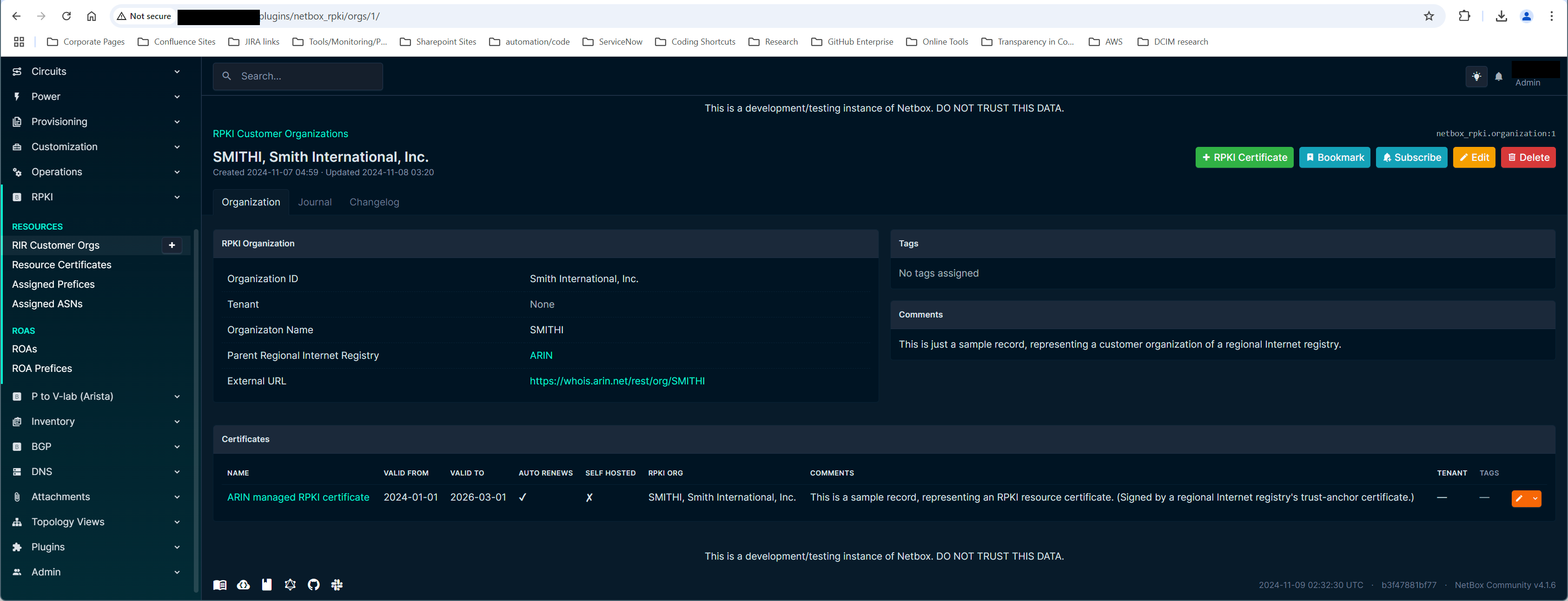
RPKI inventory covers organizations, resource certificates, ROAs, ROA prefixes, certificate prefixes, and certificate ASNs. Resource certificates and ROAs carry optional links into the broader RPKI object hierarchy through trust-anchor, publication-point, and signed-object references.
Repository and publication infrastructure models the full RPKI signed-object and publication hierarchy: repositories, publication points, trust anchors, trust anchor locators, trust anchor keys, end-entity certificates, a generic signed-object type, CRLs, revoked certificate references, manifests, manifest entries, ASPAs, ASPA providers, RSCs, RSC file hashes, and BGPsec router certificates.
External validator import captures and retains normalized output from external RPKI validators. Validator instances, validation runs, object validation results, and validated ROA and ASPA payload records hold imported observations. The included Routinator adapter ingests jsonext output from either the live API or exported snapshot files.
Routing intent lets operators define and manage publication intent for ROAs and ASPAs. Routing intent profiles, rules, context groups, context criteria, and policy bundles express derivation policy. ROA intent overrides handle explicit per-prefix exceptions. Reusable templates, template rules, template bindings, and typed exceptions support scalable policy authoring across organizations. Bulk intent runs with per-scope results drive organization-scoped derivation, and the operations dashboard surfaces stale bindings, expiring exceptions, and recent bulk-run health.
ROA and ASPA reconciliation compares derived intent against published objects. Intent derivation runs, ROA intent rows, match records, reconciliation runs, intent results, and published results form the ROA reconciliation pipeline. A parallel family covers ASPA reconciliation. External management exceptions let operators record approved, time-bounded exceptions for prefixes or objects that remain intentionally managed outside the plugin, while keeping those results visible in reconciliation. All derivation and reconciliation run and result objects are read-only reporting surfaces.
ROA lint provides configurable quality analysis of locally recorded ROA inventory through lint runs, findings, acknowledgements, suppressions, and per-rule configurations.
ROA and ASPA change planning and write-back supports reviewed, approved, and rollback-capable publication of ROA and ASPA changes to hosted providers. ROA change plans, change plan items, approval records, provider write executions, and rollback bundles implement the ROA write-back workflow. A parallel ASPA change plan family covers ASPA write-back. ROA validation simulation runs and results let operators preview approval impact before committing.
Hosted provider synchronization imports and tracks publication state for Krill and ARIN accounts. Provider accounts, sync runs, snapshots, snapshot diffs, and diff items manage import lifecycle. Imported families include ROA authorizations, ASPAs, CA metadata, parent and child CA links, resource entitlements, publication points, signed objects, and certificate observations. Stable evidence summaries on imported objects support publication-linkage, authored-linkage, freshness, and family-level churn reporting without generating false diffs across unchanged snapshots. ARIN currently supports ROA synchronization only; the shared reporting contract preserves that capability boundary explicitly.
IRR snapshot import provides a read-only correlation substrate for validating plugin-managed RPKI intent against externally managed IRR/RPSL intent. IRR sources and retained snapshots hold normalized imported objects (route, route6, route-set, as-set, aut-num, mntner) from configured external IRR sources. Coordination runs and results compare RPKI-derived intent against observed IRR state. IRR change plans and write executions model planned corrections to external IRR records based on coordination findings. The included adapter targets IRRd-compatible sources; snapshot-file import is also supported.
Delegated authorization models operator posture for delegated RPKI entities. Delegated authorization entities, managed authorization relationships, authored CA relationships, authored AS-sets, and delegated publication workflows track delegated topology and publication state. Delegation workflows support API and web-UI approval, and detail views expose readiness, approval state, and authored-topology linkage summaries.
BGP telemetry captures imported MRT-derived route-visibility data through telemetry sources, telemetry runs, and BGP path observations. Each observation stores raw AS-path text, normalized ASN-sequence JSON, and a stable path hash for correlation and historical comparison against intent and reconciliation surfaces.
Lifecycle health provides a structured event substrate for tracking certificate and object lifecycle health through policies, hooks, and events.
Models / DB tables
Core inventory models
Organization
Represents a customer or consumer of RIR RPKI services.
Fields include
org_id,name,ext_url, andparent_rir.
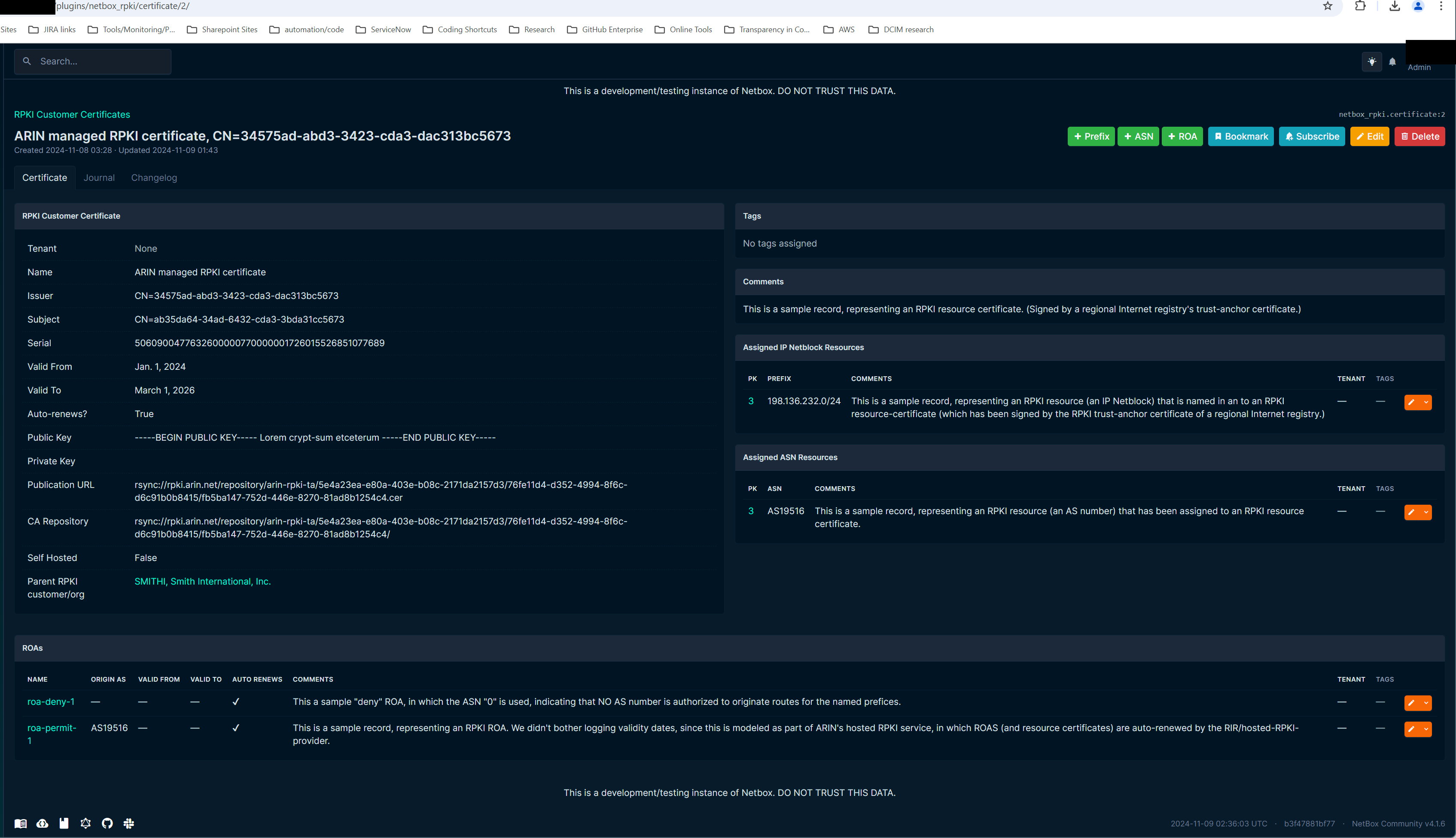
Resource Certificate
Represents an RPKI resource certificate.
Tracks identity and lifecycle fields including
issuer,subject,serial,valid_from,valid_to,auto_renews,public_key,publication_url,ca_repository,self_hosted, andrpki_org.Links optionally to a trust anchor and a publication point.
ROA Prefix
Represents the attestation relationship between a ROA and a prefix, including
max_length.Available through the plugin but not a top-level menu item.
Certificate Prefix
Represents the relationship between a resource certificate and a prefix.
Available through the plugin but not a top-level menu item.
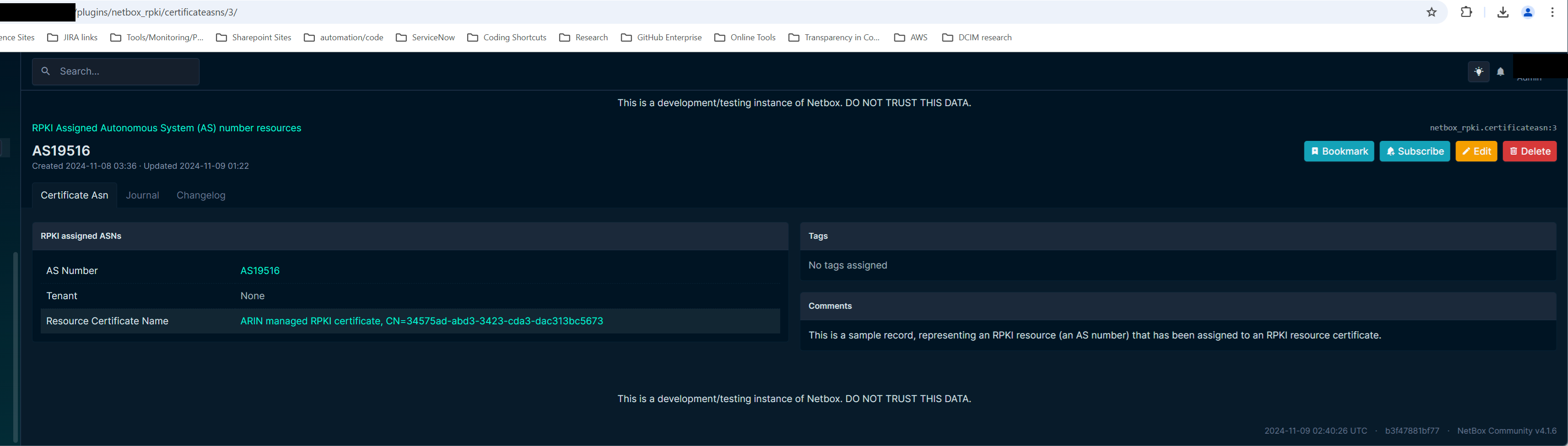
Certificate ASN
Represents the relationship between a resource certificate and an ASN.
Available through the plugin but not a top-level menu item.
Repository and publication models
Repository
Represents an rsync, RRDP, or mixed repository endpoint.
Publication Point
Represents a publication location within a repository and tracks retrieval and validation state.
Trust and certificate hierarchy models
Trust Anchor
Represents a trust anchor and its rollover state.
Trust Anchor Locator
Stores TAL-style discovery information for a trust anchor.
Trust Anchor Key
Represents a published trust-anchor key object and its rollover relationships.
End-Entity Certificate
Represents the EE certificate used to sign individual RPKI signed objects.
Signed object and repository-integrity models
Signed Object
Generic record for published RPKI signed objects including ROAs, manifests, ASPAs, RSCs, and trust-anchor keys.
Tracks object type, publication metadata, manifest linkage, CMS metadata, validity, and validation state.
Certificate Revocation List
Represents a CRL issued by a resource certificate, linked to publication and manifest state.
Revoked Certificate
Represents an individual revoked certificate or EE certificate reference carried by a CRL.
Manifest
Represents an RPKI manifest object.
Manifest Entry
Represents an individual manifest member, with optional links to the referenced signed object, certificate, EE certificate, or CRL.
Additional signed-object families
ASPA
Represents an Autonomous System Provider Authorization object.
ASPA Provider
Represents a provider ASN authorized by an ASPA.
RSC
Represents an RPKI Signed Checklist object.
RSC File Hash
Represents an individual file-hash member of an RSC.
Router Certificate
Represents a BGPsec router certificate tied to an ASN, resource certificate, and publication point.
Validation and validated-payload models
Validator Instance
Represents an external RPKI validator and its current run state.
Validation Run
Represents one validation execution against repository content.
Object Validation Result
Stores validation outcome and disposition for an individual signed object.
Validated ROA Payload
Represents a validated prefix-origin payload imported from a validator run.
Validated ASPA Payload
Represents a validated customer-provider authorization payload imported from a validator run.
Routing Intent Profile
Defines routing-intent policy defaults, derivation trigger mode, and prefix or ASN selection behavior for an organization.
Routing Intent Rule
Represents an ordered rule used to include, exclude, or modify ROA or ASPA intent during derivation.
Routing Intent Context Group
Groups related context criteria for scoped rule evaluation.
Routing Intent Context Criterion
Represents an individual matching criterion within a context group.
Routing Intent Policy Bundle
Collects a set of profiles and their associated rules into a reusable policy bundle.
ROA Intent Override
Represents an explicit per-prefix or per-scope exception to derived ROA intent.
Routing Intent Template
Represents a reusable routing-intent template that can be bound to organizations to generate profiles and rules.
Routing Intent Template Rule
Represents an ordered rule within a routing intent template.
Routing Intent Template Binding
Represents the association between a template and a target organization, including binding state and generated profile references.
Routing Intent Exception
Represents a typed exception encountered during intent derivation, with configurable effect modes.
Bulk Intent Run
Represents an organization-scoped bulk derivation run, including trigger mode, target scope, and overall run health.
Bulk Intent Run Scope Result
Stores the per-scope result of a single organization within a bulk intent run.
ROA reconciliation models
Intent Derivation Run
Stores metadata for a derived-intent calculation run.
Read-only reporting surface.
ROA Intent
Represents a derived ROA intent row tied to a derivation run, profile, scope, and optional override.
Read-only reporting surface.
ROA Intent Match
Stores a candidate match between a derived intent row and a locally recorded ROA.
Read-only reporting surface.
ROA Reconciliation Run
Stores metadata for a reconciliation comparison between ROA intent and published ROA records.
Read-only reporting surface.
ROA Intent Result
Stores the intent-side reconciliation result for a derived ROA intent row.
Read-only reporting surface.
Published ROA Result
Stores the published-side reconciliation result for a recorded ROA.
Read-only reporting surface.
ASPA reconciliation models
ASPA Intent
Represents a derived ASPA intent row tied to a derivation run, profile, and scope.
Read-only reporting surface.
ASPA Intent Match
Stores a candidate match between a derived ASPA intent row and a locally recorded ASPA.
Read-only reporting surface.
ASPA Reconciliation Run
Stores metadata for a reconciliation comparison between ASPA intent and published ASPA records.
Read-only reporting surface.
ASPA Intent Result
Stores the intent-side reconciliation result for a derived ASPA intent row.
Read-only reporting surface.
Published ASPA Result
Stores the published-side reconciliation result for a recorded ASPA.
Read-only reporting surface.
ROA lint models
ROA Lint Run
Represents one execution of the ROA lint analysis against locally recorded ROA inventory.
ROA Lint Finding
Represents an individual quality finding produced during a lint run.
ROA Lint Acknowledgement
Records an operator acknowledgement of a lint finding.
ROA Lint Suppression
Represents a configured suppression rule that mutes specific lint finding types.
ROA Lint Rule Config
Stores per-rule configuration controlling lint severity and enablement.
External Management Exception
Records an approved external-management exception for a ROA prefix, ROA object, ASPA customer scope, or imported/local published object, including owner, reason, start, review, and end dates.
ROA change plan and write-back models
ROA Change Plan
Represents a set of planned ROA create, update, or delete operations against a hosted provider, including approval and execution state.
ROA Change Plan Item
Represents an individual ROA operation within a change plan.
Approval Record
Records an approval decision for a change plan, including approver identity and timestamp.
Provider Write Execution
Represents one execution of a change plan against the target hosted provider, including per-item outcomes.
ROA Change Plan Rollback Bundle
Stores the rollback state for a completed ROA change plan execution.
ASPA change plan and write-back models
ASPA Change Plan
Represents a set of planned ASPA create, update, or delete operations against a hosted provider, including approval and execution state.
ASPA Change Plan Item
Represents an individual ASPA operation within an ASPA change plan.
ASPA Change Plan Rollback Bundle
Stores the rollback state for a completed ASPA change plan execution.
ROA validation simulation models
ROA Validation Simulation Run
Represents a simulation run that evaluates how a set of planned ROA changes would affect RPKI validation outcomes for observed routes.
ROA Validation Simulation Result
Stores the per-route validation outcome and approval impact produced by a simulation run.
Provider account and sync models
RPKI Provider Account
Represents a Krill or ARIN hosted-provider account, including connection parameters, sync state, and capability metadata.
Provider Sync Run
Represents one import execution against a provider account.
Provider Snapshot
Represents the normalized state of a provider account’s published objects at the time of a sync run, with family-level rollup summaries.
Provider Snapshot Diff
Represents the diff between two consecutive provider snapshots, with family-level churn summaries.
Provider Snapshot Diff Item
Represents an individual create, update, or delete change between two snapshots.
Imported provider inventory models
External Object Reference
Stores a stable external identity reference linking an imported object to its provider-assigned identifier.
Imported ASPA
Represents an imported ASPA record from a hosted provider.
Imported ASPA Provider
Represents an individual provider ASN within an imported ASPA.
Imported CA Metadata
Represents imported metadata about a CA instance within a hosted provider account.
Imported Parent Link
Represents an imported parent CA relationship observed on a provider account.
Imported Child Link
Represents an imported child CA relationship observed on a provider account.
Imported Resource Entitlement
Represents an imported IP prefix or ASN resource entitlement associated with a CA within a provider account.
Imported Publication Point
Represents an imported publication point observation from a hosted provider, with evidence summaries for publication linkage and freshness.
Imported Signed Object
Represents an imported signed object observation from a hosted provider, with evidence summaries for manifest linkage and publication state.
Imported Certificate Observation
Represents an imported certificate observation associated with a CA within a provider account.
IRR import models
IRR Source
Represents a configured external IRR source used to import RPSL objects for RPKI intent correlation.
IRR Snapshot
Represents a retained snapshot of imported IRR data from a source, including import status and object counts by family.
Imported IRR Route Object
Represents an imported
routeorroute6RPSL object from an IRR snapshot.
Imported IRR Route Set
Represents an imported
route-setRPSL object from an IRR snapshot.
Imported IRR Route Set Member
Represents an individual member of an imported route set.
Imported IRR AS Set
Represents an imported
as-setRPSL object from an IRR snapshot.
Imported IRR AS Set Member
Represents an individual ASN or nested set reference within an imported AS set.
Imported IRR Aut-Num
Represents an imported
aut-numRPSL object from an IRR snapshot.
Imported IRR Maintainer
Represents an imported
mntnerRPSL object from an IRR snapshot.
IRR Coordination Run
Represents one execution of RPKI-vs-IRR coordination analysis, comparing plugin-managed RPKI intent against imported IRR data.
IRR Coordination Result
Stores the per-object comparison result from a coordination run.
IRR Change Plan
Represents a set of planned corrections to external IRR records based on coordination findings.
IRR Change Plan Item
Represents an individual IRR object operation within a change plan.
IRR Write Execution
Represents one execution of an IRR change plan against the target IRR source.
Delegated Publication Workflow
Represents a publication workflow initiated by a delegated entity, including approval state and authored object references.
BGP telemetry models
Telemetry Source
Represents a configured source of MRT-derived BGP telemetry data.
Telemetry Run
Represents one import execution against a telemetry source.
BGP Path Observation
Represents an observed BGP path from an imported telemetry snapshot.
Stores raw AS-path text, normalized ASN-sequence JSON, and a stable path hash for correlation and historical comparison.
Lifecycle health models
Lifecycle Health Policy
Defines a set of lifecycle health rules applied to a monitored RPKI object family.
Lifecycle Health Hook
Represents a configured hook within a lifecycle health policy that triggers on specific lifecycle events or conditions.
Lifecycle Health Event
Represents a recorded lifecycle health event produced by a hook evaluation.
Screenshots
RPKI Organizations/Certificates/Resources
RPKI ROAs
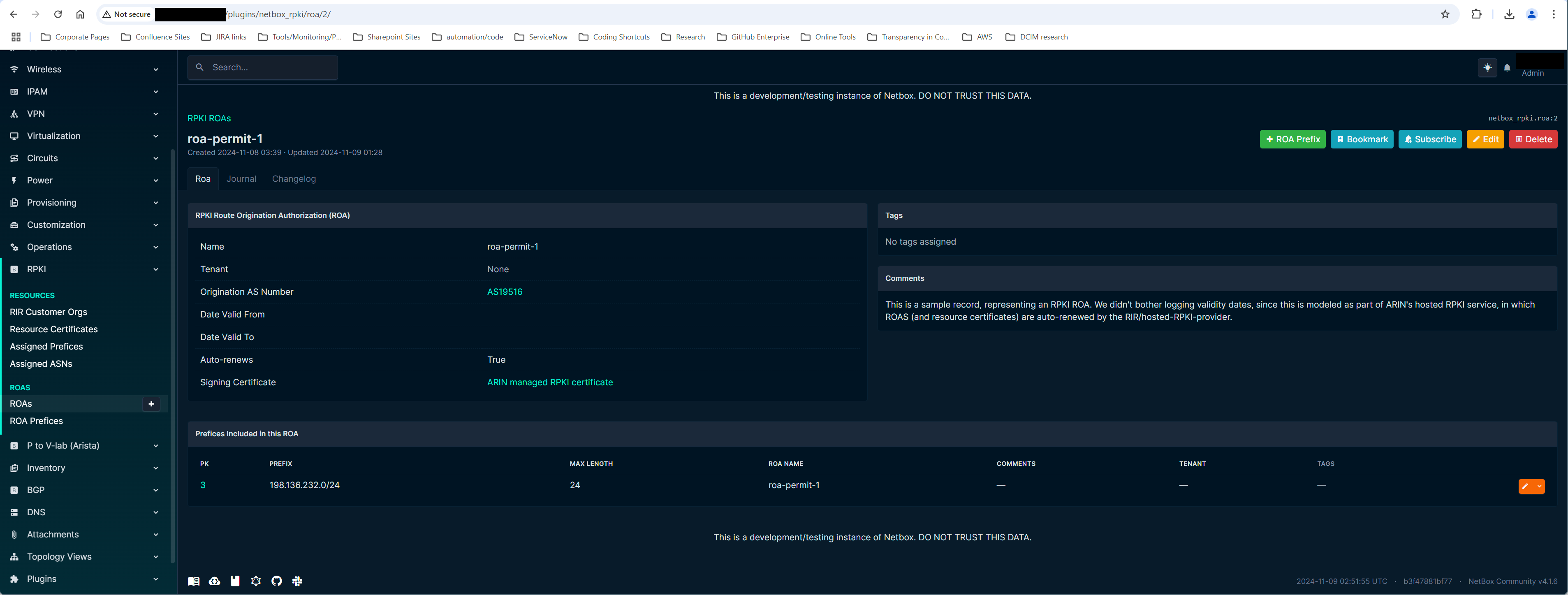
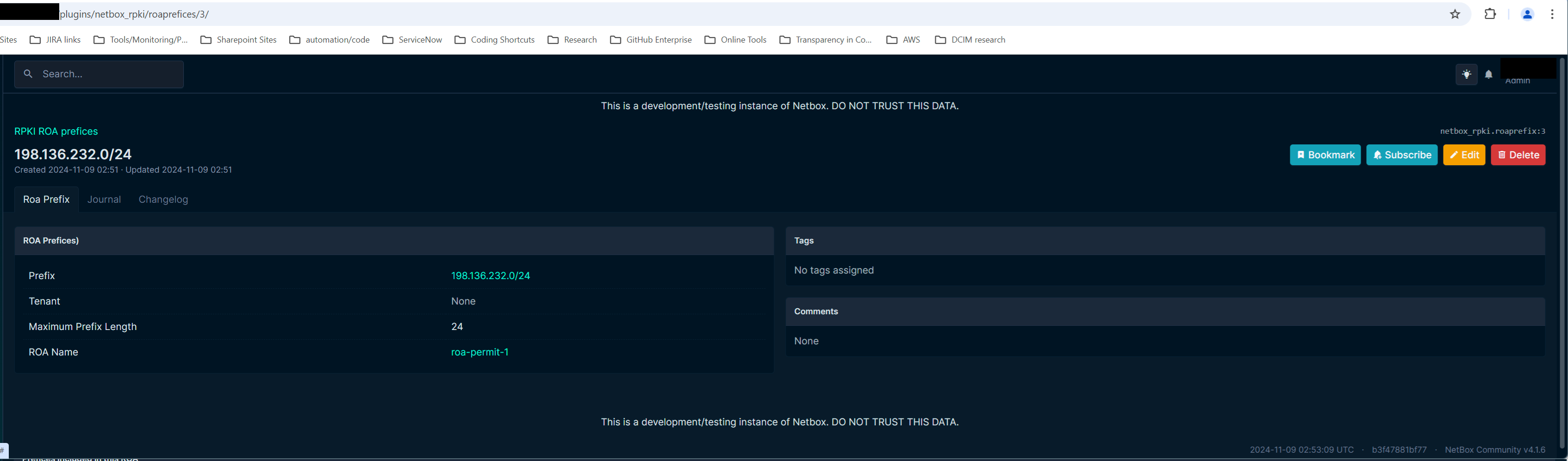
Browser E2E Tests
The repo includes a minimal Playwright suite under tests/e2e/ for real plugin Web UI CRUD coverage.
It targets a running local NetBox dev instance, defaulting to
http://127.0.0.1:8000It logs in as the local
adminuser created bydevrun/dev.sh startIt prepares only the core NetBox prerequisites the plugin forms depend on and cleans up prior E2E-marked plugin objects
It does not require
dev.sh seed, though seeded data remains compatible with the suiteThe recommended entry point in WSL is
cd devrun && ./dev.sh e2e
See tests/e2e/README.md for setup, environment variables, and exact commands.